

Defending Heinlein: Friday
Part One of a multi-part series exploring and defending some of Robert A. Heinlein's most controversial books.
Trigger Warning: I’m usually not a fan of these as I feel they serve to prejudice an audience to have a certain reaction rather than warning about sensitive content. That being said, the following does contain discussion surrounding the topic of sexual assault/violence. Proceed with caution.
As I’ve previously stated, Robert A. Heinlein is one of the two authors who have most influenced my own writing. I’ve read nearly every book written by sci-fi’s first Grand Master. Some I like more than others. Some which I love I know that others dislike or downright hate. A few of his books have become very controversial over the last ten or fifteen years.
In this installment I’m going to discus my least favorite of Heinlein’s controversial books: Friday.
Friday was one of the first Heinlein books I ever read. I started off with Starship Troopers, and then read The Cat Who Walks Through Walls, which was followed by Time Enough For Love and then Friday. Friday is one of my wife’s favorite Heinlein novels and at the time I only read it because of how strongly she recommended the book.
I won’t say I hated the book then. I just didn’t really enjoy it all that much. I could never articulate why until recently. It didn’t read like other Heinlein books. Even now, nearly twenty years after my first reading, I can say it still doesn’t. Nor does it read like the other four books Heinlein produced between 1980 and his death in 1988.
The reason why is very simple: Heinlein beats you over the head with the theme of the book. More so than any of his other books, Friday is unrelenting when it comes to the central theme of the book. Which is part of why it’s so odd that so many people have missed this important message.
I’ve often wondered, when reading reviews of Friday, if this point is glossed over out of ignorance or malice. Given Heinlein’s heavy hand on the topic, I usually assume it to be malice. If you ignore the central theme of the book, it becomes much easier to target the book and the author for certain aspects of the book.
What is this central theme?
“What makes a person ‘human’? What is ‘humanity’ and how do we define it?”
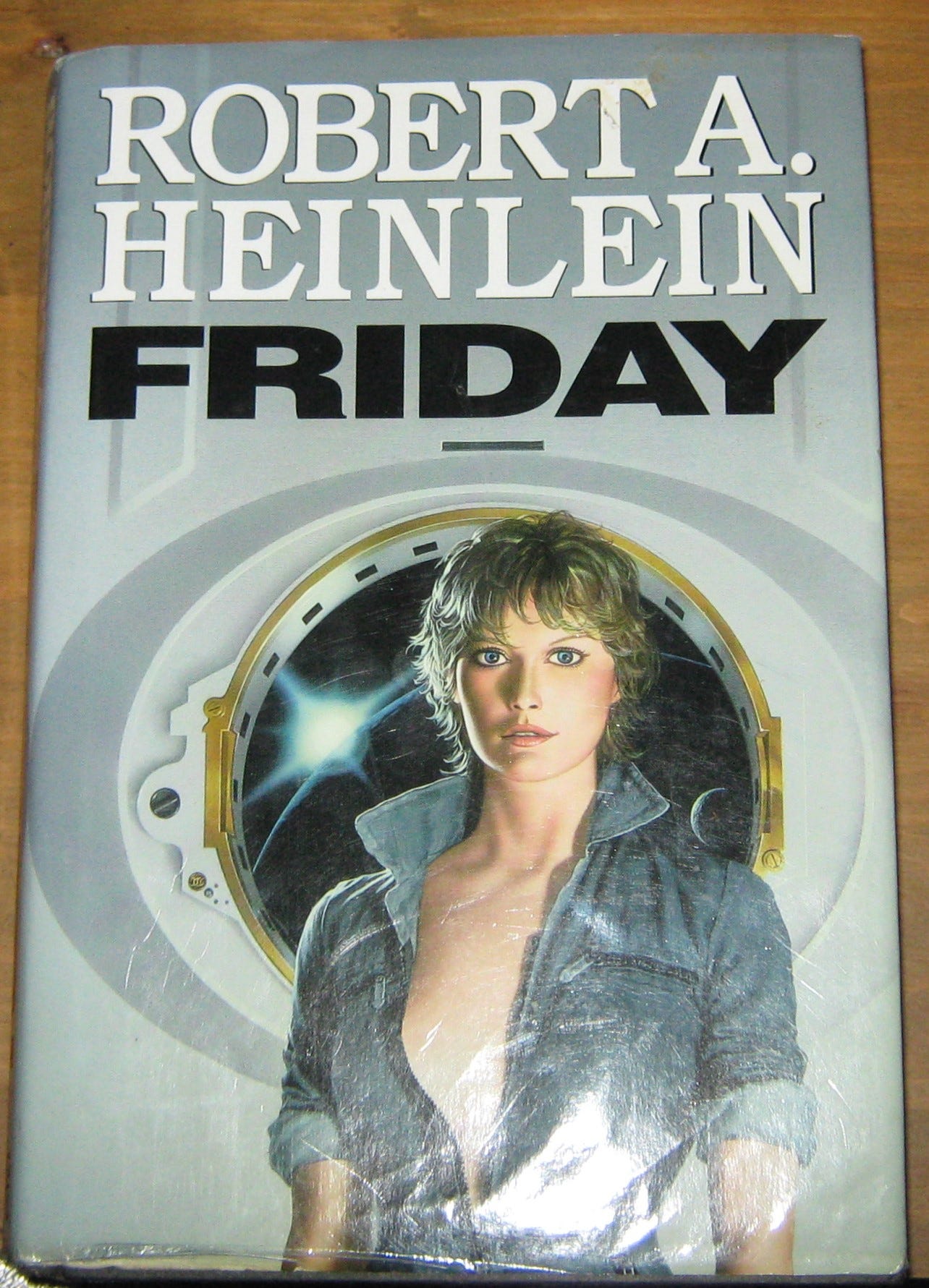
Let’s set the stage: in Friday the main protagonist is a young woman whom we meet simply as Friday, later given the surname Baldwin. Friday is the top combat courier in her elite organization which is run by a man whom she only refers to as Boss. Friday is also an Artificial Person.
An Artificial Person or AP, is the product of genetic manipulation. No mere IVF “test tube baby”, APs are created by splicing the genes of several donors to create a person of requisite height, weight, skin color, eye color, hair color, athletic ability and intelligence. APs are treated more as property rather than as people.
“ “Am I? The courts say I can’t be a citizen; the churches say I don’t have a soul. I’m not ‘man born of woman,’ at least not in the eyes of the law.” ” -As stated by Friday
Friday has known her whole life that she is an AP and has always run up against this prejudice. She was not born as ‘humans’ are born. She was not raised as a ‘normal’ child would be raised. Instead she spent her earliest years being reared in a crèche (think half laboratory, half day care). Her earliest training is as a doxy. For those wondering, a doxy is a mistress or prostitute. Given the legal status of APs, it’s probably much more apt to say ‘sex slave’.
Friday is literally purchased by the man she would call Boss, who is in many ways her father. Boss has her trained as a combat courier and even helps devise a legal cover for her so she can stop presenting herself as an AP to the world at large. But Friday always suffers from knowing her true origins and how society would/does treat her when her mask slips.
This message is impossible to miss. It is referred to repeatedly in the book. Friday does not view herself as human. As such, her reactions and behavior are not the reaction a normal human would have. How could they be?
Which brings me neatly around to the part of the book that seems to upset people the most: Friday is the victim of a gang rape.
Returning to her base of operations after a trip to one of the space stations, Friday is attacked by a group of mercenaries who are working for a competitor to her own organization. In their attempt to grab Friday, two men are killed and three severely injured. After they have subdued Friday, she is then gang raped in an attempt to soften her up for interrogation.
“But why waste time raping me? The whole operation had amateurish touches. No professional group uses either beating or rape before interrogation today; there is no profit in it; any professional is trained to cope with either or both. For rape she (or he—I hear it’s worse for males) can either detach the mind and wait for it to be over, or (advanced training) emulate the ancient Chinese adage.
Or, in place of method A or B, or combined with B if the agent’s histrionic ability is up to it, the victim can treat rape as an opportunity to gain and edge over her captors. I’m no great shakes as an actress but I try and, while it has never enable me to turn the tables on unfriendlies, at least once it kept me alive.” Friday, pg 9-10
One review from the New York Times suggests that Friday enjoys her rape. Given the above quote, it’s obvious she doesn’t actually enjoy it. She may act like she enjoys it and may not be actively resisting, but she doesn’t truly enjoy it. It’s an act. A ploy. A way to try and turn a bad situation around and maybe gain the upper hand.
Given that by this point Friday has already killed several men, it’s not too much of a stretch to imagine what she would do to her captors given the opportunity. Her captors relent, realizing that their plan isn’t working and then move on to other interrogation techniques including drugs and physical torture.
I’ve also seen some people claim that Friday just brushes off her attack and goes on like it never happened. Yet, if you read the book, it’s made clear that she receives not only the best medical care available to heal her physical injuries (including having one nipple regenerated) but also undergoes subtle therapy to heal her emotional wounds.
Part of how Friday is able to cope with all of this stems from her knowledge that she is an Artificial Person. She knows that a ‘human’ woman would suffer severe emotional trauma from such a scenario, but Friday doesn’t see herself as human. Between her status as an AP and her training as both a doxy and a courier, it makes sense that she doesn’t necessarily view rape the same way a ‘human’ woman would.
Though it must be admitted that this isn’t wholly true as Friday wishes to take revenge against one of her attackers personally. Promising to make him suffer before she kills him. She’s denied the opportunity as he dies during her rescue, but she is pleased to learn that he didn’t die quickly or painlessly.
To speak more broadly about Heinlein’s views on rape all one need to do is read The Moon is a Harsh Mistress and see how rapists are dealt with in Luna… In fact, in many of Heinlein’s worlds rape is rare to nonexistent and the women who populate those worlds are armed and/or well trained enough that the attempt would end badly for any male who tried.
There’s more sex in the book. All consensual, none truly graphic, but still derided by the critics as being ‘unrealistic’ to some standard of behavior they have for how/when/why a woman is supposed to have sex. I think it a bit strange that some of these critics have no problem with ‘free love’ per se, but seem to hate it when it’s written by ‘an old, white, cis-het male’.
I think for some, these later sexual encounters are colored by the rape in the second chapter. I know that the critics once again ignore the overall theme of the book and don’t take into account that for Friday, sex is one of the ways she can share herself and feel human and embrace her humanity. And so it is for nearly the entire book. It always comes back to Friday not feeling like she is human. And that feeling colors all of her interactions and decisions throughout.
“You forgot the worst part,” screams the critic in my mind, his scarecrow-like fist raised in agitation.
The end of the book.
I’m going to simplify this so as not to completely spoil the ending if you do choose to read Friday.
Friday encounters one of her attackers from the beginning of the book. When she recognizes him she threatens to turn him in. She ends up questioning him about his involvement and she ultimately decides not to kill him. She has her reasons. She doesn’t come to this decision lightly and is ready to kill the man on the spot otherwise. It makes sense, given her character. He does end up helping her significantly at the end of the book. People hate this.
That last bit is a little hard to defend. Probably because we like to think that things are more simple than they actually are. In fiction we want clear sides. Black vs White. Right vs Wrong. Good vs Evil. In this case, there’s some heavy gray shading, just like there is in real life.
And there we have it: my defense of Friday. A lot of the other criticism I’ve seen of this book is the bad faith ‘that’s not how I would have wrote that’ variety. Stuff like Heinlein spending too much time describing breakfast. Getting too deep into how credit cards work in a Balkanized North America. I personally enjoy the deep world building going on through the credit/finance stuff. As far as the breakfast stuff, what’s more human than enjoying a delicious meal shared with the people you love? Edo ergo sum